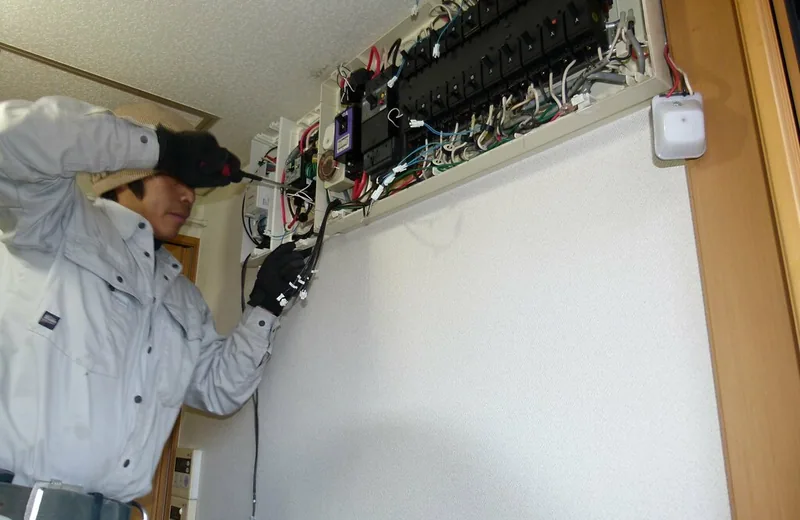
Electrical work covers very different situations under one trade: a power outage on a weeknight or a breaker that keeps tripping have nothing in common, urgency-wise, with a wallbox installation booked for next month or a switchboard compliance upgrade planned two months out. A leads marketplace has to handle this gap while keeping the same underlying mechanism: it remains an intermediary between electrical companies and several sources of customer requests, applying shared rules for verification and scoring.
This guide is for electrical companies considering receiving leads as well as for referral partners who might supply them. We cover the mechanism specific to this trade: how an emergency request is separated from a planned project as soon as it enters the platform, how each one gets scored, what sets an exclusive lead apart from a shared one depending on the nature of the job, how to compare several providers active in the same category, and which Swiss data protection rules govern this exchange — including for information that can describe a risky state of an electrical installation.
How the electrician leads marketplace works
On the marketplace, an electrical request is first classified by urgency. A power outage, a short circuit, a burning smell, or a breaker that keeps tripping falls under emergency callouts: these requests are flagged as priority and routed quickly to available electricians in the area. A planned project — a full rewiring job, a switchboard compliance upgrade, an EV charger installation, a home automation integration — follows a different path: the platform collects more detail before distributing it (area involved, age of the installation, desired timeline), because the customer doesn't need an answer within the hour.
On the company side, this split shows up in the intake profile: a company can choose to receive only emergency callouts, only planned projects, or both, with different routing rules depending on the request type. On the supply side, referral partners have to respect the same classification: a mislabelled emergency request that lands in the wrong feed loses most of its value — something that's also checked when scoring the source.
- Every request is classified as soon as it enters: emergency callout or planned project.
- Emergency requests (outage, short circuit, burning smell) are flagged and routed with priority.
- A planned project collects more detail (area, age of the installation, desired timeline) before distribution.
- The company chooses to receive one feed, the other, or both under separate routing rules.
Lead quality and scoring for electricians
Every request is assessed before being offered to a company: validity of the Swiss phone number, coherence of the e-mail address, a technical description of the need (which part of the installation is affected — switchboard, sockets, lighting, EV charger), and proof of explicit consent to be contacted. For electrically risky situations — visible sparks, a burning smell, a breaker that keeps re-tripping — a priority safety flag is added to the score independently of everything else, because this type of request needs to reach an available company without delay.
For planned projects, scoring factors in a different signal: how genuine the intent actually is. A compliance upgrade or a switchboard renovation request that states a desired timeline and a clear context (an upcoming move, a mandatory electrical inspection, a home extension) scores higher than a vague request submitted with no real follow-through intent. As with every category on the marketplace, the track record of the source that submitted the request also factors in: a partner who repeatedly submits unreachable contacts sees its flow downgraded.
- Verified details and a technical description of the need (switchboard, sockets, lighting, EV charger).
- Priority safety flag for risky situations: sparks, burning smell, a breaker that keeps tripping.
- For a planned project, the desired timeline and context of the request are collected and scored.
- Source track record factored in: a partner submitting unreachable contacts gets downgraded.
Exclusive or shared leads: a trade-off driven by urgency
Exclusivity is explicitly chosen by the electrical company in its intake profile, but its value shifts a lot depending on the nature of the request. Facing an electrical emergency, a customer often contacts several companies in parallel out of necessity — waiting for a single reply isn't an option when the power is out. A shared lead on emergency callouts can stay profitable for a company that answers fast, and a slightly wider distribution on this segment doesn't necessarily hurt the buyer, as long as the number of recipients stays capped and disclosed in advance.
On a planned project, the logic flips: a switchboard compliance upgrade or a full rewiring job involves a detailed quote, sometimes a technical visit, and a customer who doesn't want to juggle five appointments in parallel. Exclusivity limits how the customer's attention gets split and often justifies a higher price for this type of lead, which carries a larger average ticket than a simple callout. Many companies combine both approaches: shared leads on callouts to maximise volume, exclusive leads on planned projects to maximise the close rate.
How to compare electrician lead providers
In this category, not every provider treats emergencies and planned projects with the same rigour. Before committing, it's worth checking whether a provider genuinely separates the two feeds or lumps everything into one generic stream — an emergency lead buried in an untriaged feed loses most of its value. Compare the origin of requests too (the platform's own forms, verified partners, or bulk-bought data), the replacement policy for invalid leads, and how clear the pricing model is.
A serious marketplace openly shares its average conversion rates by request type, how quickly it handles a complaint, and the split between exclusive and shared leads in the electrician category. Be wary of a provider that can't tell you whether a given request is an emergency or a planned project, or that won't disclose where its contacts come from: on a transparent marketplace, this information is part of the service.
- Genuine separation between the emergency feed and the planned-project feed, not one generic stream.
- Declared origin of requests: own forms, verified partners, never bulk data.
- Clear replacement policy for invalid or unreachable leads.
- Average conversion rates shared per request type, not just promised.
Legal framework: Swiss data protection on an electrician leads marketplace
Three parties are involved in data handling for this category: the end customer, the partner who collected the request, and the electrical company that receives it. The Swiss federal data protection act (nLPD) applies at every step, including when the request describes the state of an electrical installation or a risky situation in a home: the customer must have given explicit consent to be contacted by a professional in the sector, and that consent must be traceable, not simply asserted by the platform.
As the receiving company, check that the marketplace can demonstrate the origin of consent and that it applies the same standard across all its providers, for callouts and planned projects alike. You remain responsible for how you handle the contact details once received: keep them only as long as needed to process the request, and respect the customer's right to opt out of further contact, particularly for project requests that can stay open for several weeks.